Reese’s Traumatic Experience and PTSD
Off CampusReese’s Traumatic Experience and PTSD are presented through their continuing effects on his body, relationships, and everyday choices. Reese’s startle responses and fear of being physically controlled make intimacy contingent on safety and consent; his account of the trauma, his father’s advocacy, and the difficult work of therapy show that support does not erase what happened, but can make room for Reese to confront it on his own terms.
Symptoms and the Need for Safety
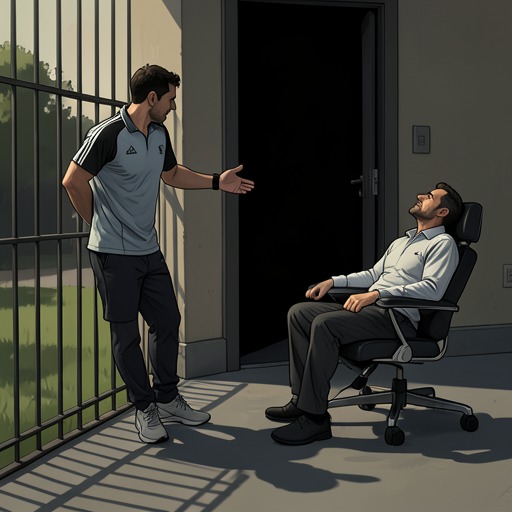
When Tom enters their Perkins room, Reese whirls around and drags his desk chair between himself and the door. Bare-chested and breathing hard, he grips the chair with white fingers, his eyes wide and blank. Tom freezes, afraid Reese may raise the chair and shove it at him. The scene makes Reese’s alarm visible before either man can explain it: an ordinary entrance has become a perceived threat, and the furniture between them serves as an improvised barrier.
Reese’s trauma also shapes what kinds of touch feel safe. During an intimate moment with Tom, he says “Wait.” His hands are flat against Tom’s chest, not quite pushing him away, but Tom lets go. Later, Reese makes the distinction explicit: Tom may touch him, but must not hold him down or move his body. He gives Tom permission to explore him while setting that boundary, turning consent into a concrete practice of choice and control rather than an assumption that closeness makes all touch acceptable.
The limits remain situational, not permanently settled. When Tom later plans to approach Reese while kneeling, he has spent hours thinking through how to avoid bringing up bad feelings or triggering a flashback. Yet the soft thwap of a pillow hitting the floor makes Reese jerk back and cross his arms over his chest. The contrast between Tom’s careful intention and Reese’s immediate startle response shows how little control either person has over what may become frightening, even in a moment prepared with care.
Disclosure and Family Support
Reese explains that his presence at Perkins was part of what the school had to promise his father before his father would allow him to return; the arrangement was also meant to keep him from going to the press. This disclosure places Reese’s return to school within a negotiated effort to secure his safety. It also establishes that his father is actively involved in decisions surrounding his recovery, rather than treating Reese’s return as an uncomplicated resumption of college life.
Tom learns more about the consequences of the assault in a conversation with Reese’s father. Tom explains that Reese cannot be held tightly because being wrapped in someone’s arms reminds him too much of what happened. Reese’s father folds inward at this recognition. He says that, if Reese’s mother were there, he would want to curl up with her and hold on; instead, he asks Tom to hold Reese’s hand. The request is modest and specific, acknowledging both the comfort of physical closeness and the forms of touch Reese cannot safely receive. Tom agrees, and the exchange moves both men to tears.
The hand-holding also has a history within the relationship. Tom remembers first taking Reese’s hand after finding him in the Perkins living room during a party and leading him back to their room, conscious of other people watching. In the later conversation, the gesture acquires a further meaning: it is a form of closeness Reese’s father can endorse precisely because it respects his son’s limits. Care here is not measured by how much contact Tom can offer, but by whether the contact can be safe for Reese.
Intimacy, Consent, and Trust
Reese’s boundary-setting does not rule out sexual intimacy. In one scene, he tells Tom that this is different and that Tom can touch him anywhere, then immediately qualifies that permission by asking not to be held down or physically moved. Tom agrees, touches him gently, and removes Reese’s shirt only after Reese raises his arms. The scene holds desire and caution together: Reese chooses what he welcomes, while Tom’s attention to the limit becomes part of their shared intimacy.
That negotiation matters because Tom knows Reese may have a flashback. Before his first attempt to perform oral sex on Reese, Tom imagines how the encounter might unfold and worries that he could inadvertently bring painful feelings to the surface. His concern does not make him an expert in Reese’s trauma, and planning cannot guarantee that Reese will remain untriggered. The sudden noise of the pillow demonstrates that gap between care and control. The novel therefore treats intimacy as something the two men must keep negotiating, not as a cure that makes the trauma disappear.
Therapy and the Burden of Repetition
Reese describes talk therapy as both understandable and exhausting. He knows that recounting what happened is meant to help him gain control over it and eventually speak or think about it without freezing or having a panic attack. He also resents being asked to return to the details again and again, and says he does not want to continue. His frustration captures the cost of recovery: understanding the purpose of therapy does not make repeated disclosure easy, and the process can feel like another demand placed on an already crowded life.
Tom stays on his bed rather than approaching Reese while he is seething, recognizing that physical comfort may not be welcome in that moment. When Tom later cries, he tries to blame the emotion on having developed feelings for Reese. Reese rejects that explanation sharply: Tom is crying because he has allowed himself to feel, and because his life is still in ruins; Reese tells him not to blame it on gay feelings or on Reese. The argument does not resolve either man’s distress, but it prevents Tom from turning Reese into the explanation for pain that belongs to his own life as well.
Narrative Significance
The novel conveys Reese’s PTSD through recurring negotiations among body, space, sound, and speech. The chair placed between Reese and the door, the sudden recoil from a pillow’s impact, and the distinctions he draws between welcome touch and restraint make the trauma legible in immediate physical terms. His account of therapy adds a different kind of recurrence: the work of naming what happened is repetitive, difficult, and not reducible to one decisive disclosure.
Support is consequently shown as specific rather than curative. Tom listens when Reese explains why he is at Perkins, stops when Reese says “Wait,” and accepts explicit limits on touch; Reese’s father asks for hand-holding instead of an embrace he knows his son cannot tolerate. These responses create possibilities for closeness without suggesting that affection or sexual intimacy replaces therapy or removes the aftereffects of assault. Reese’s recovery remains an ongoing negotiation in which safety depends on being heard, believed, and allowed to choose.